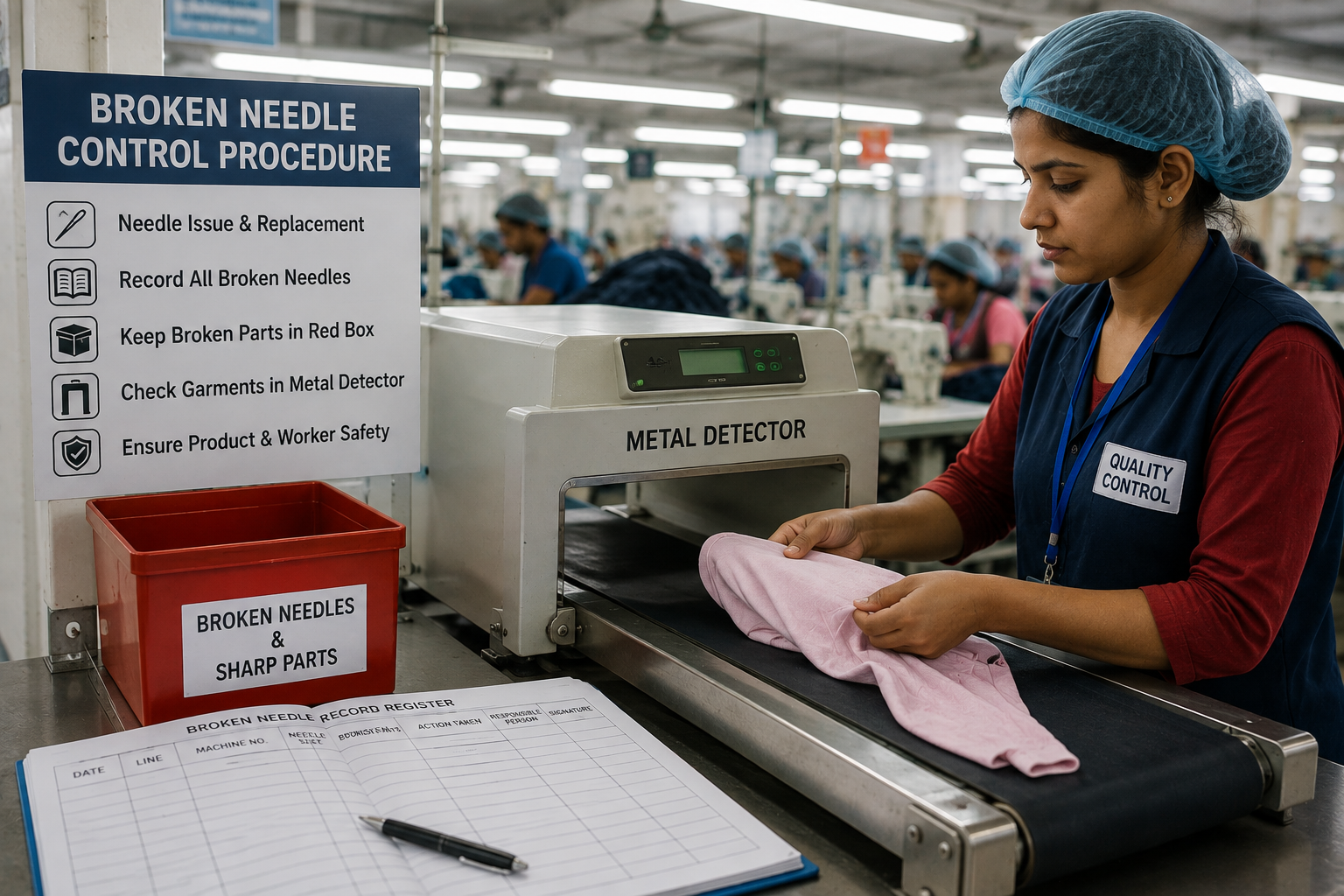
Safety is one of the most important considerations in garment manufacturing, especially when the finished garments are going to be worn by consumers. There is a chance that needles and other sharp metal objects used for manufacturing the products may still be on the garment. This is harmful for the consumer, and the chances of injury are high.
A broken needle policy helps garment factories establish a systematic process for controlling needles, recording broken parts, and checking garments before they are packed. For apparel manufacturers supplying leading international brands, following these procedures is also an important part of meeting buyer requirements and factory compliance standards.
I’ll be taking you through what a broken needle policy is and what the steps are that you can follow as an apparel manufacturer to avoid the risk of injury caused by needles and other sharp metal objects. Let’s dive in.
Check out our digital swatch here
Why Is a Broken Needle Policy Important?
Safety is the top priority to all the leading apparel brands. To eliminate the accident to the wearer due to the sharp items remaining in a garment, like a broken needle part, brands provide needle policy to their suppliers.
It is therefore mandatory that a Needle Control Procedure is adopted by all apparel manufacturers. It is not only for infant wear and kids wear manufacturers who need to follow the needle policy and each garment need to pass through the needle detector machine prior to packing the garment. Now, this becomes a discipline of the garment factory and a major component of the factory compliance checklist.
Broken needle record register (filled). Source: TWG
Blank format for Broken needle record (Source: Scribd)
What does the broken needle policy mean?
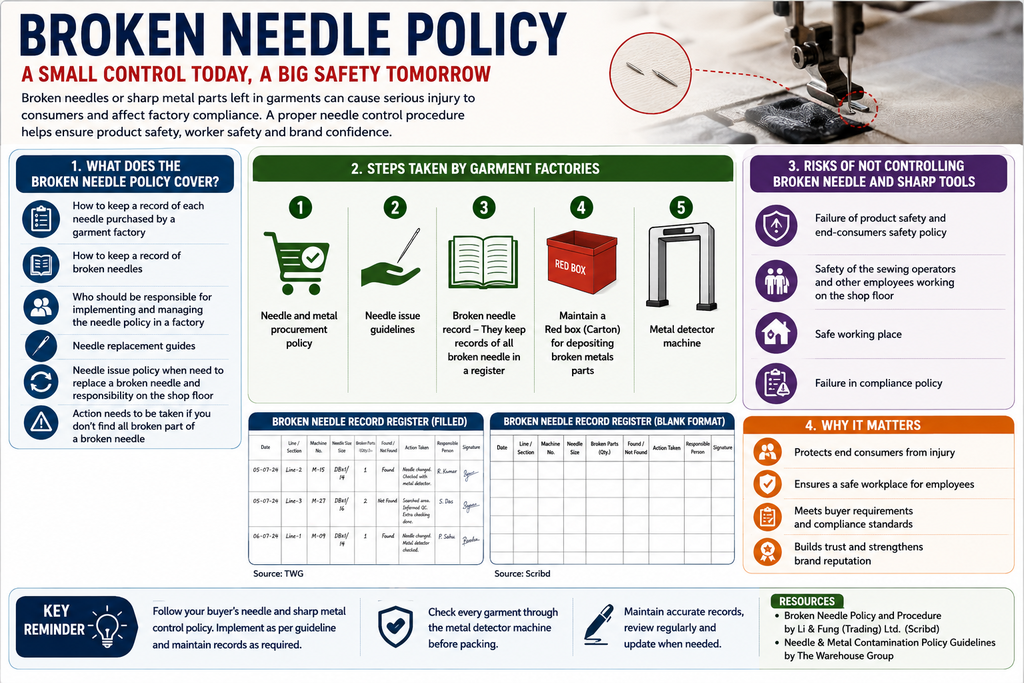
Normally, the broken needle policy covers the following details
- how to keep a record of each needle purchased by a garment factory
- how to keep a record of broken needles (See the format for broken needle record)
- who should be responsible for implementing, managing the needle policy in a factory?
- needle replacement guides,
- needle issue policy when need to replace a broken needle and responsibility of needle replacement on the shop floor
- action needs to be taken if you don’t find all broken part of a broken needle
What steps are taken by garment factories
- Needle and metal procurement policy
- Needle issue guidelines
- Broken needle record – They keep records of all broken needle in a register
- Maintain a Red box (Carton) for depositing broken metals parts
- Metal detector machine
The risk of not controlling broken needle and sharp tools
- Failure of product safety and end-consumers safety policy
- Safety of the sewing operators and other employees working on the shop floor
- Safe working place
- Failure in compliance policy
About Dinesh Exports
At Dinesh Exports, we’ve been working with the apparel and textile industry for more than three decades. We understand that producing quality garments starts well before the final product reaches the customer. Fabric quality, manufacturing consistency, sampling, technical specifications, and production controls all play an important role in the final garment.
We manufacture and supply woven fabrics for apparel brands and garment manufacturers. Our experience includes cotton fabrics, linen blends, Lyocell fabrics, yarn-dyed fabrics, and other woven fabric constructions used across different apparel categories.
For brands and manufacturers developing new collections, having a reliable fabric supplier is an important part of maintaining consistency throughout production. If you’re sourcing woven fabrics from India, our team can help you explore suitable fabric options for your requirements. If you need more information, please contact us.
Resources
In this post, I have not written the guide for the broken needle policy. Instead, I suggest you follow your buyer’s needle and sharp metal control policy. The broken needle policy guide is easily available with your buyer and buying-house. You need to implement it as per guideline and maintain the record as suggested by the buyer’s guideline.
Here I am sharing two documents found on the internet for referring to the broken needle policy and sharp items and tools control policy.
- Broken Needle Policy and Procedure by Li & Fung (Trading) Ltd. This document is uploaded on Scribd.
- Needle & Metal Contamination Policy Guidelines by The Warehouse Group – This document shows some examples of customer complaints received by email and published complaints on the social platform.
Conclusion
A broken needle may be a small part of the garment manufacturing process, but the consequences of losing control over broken needles or other sharp metal objects can be serious. This is why garment factories need to treat needle control as a regular part of their production and compliance procedures.
Maintaining proper records, controlling needle issues and replacements, keeping broken parts safely, and using metal detection where required can help factories reduce the risk of sharp objects reaching the end consumer.
For manufacturers supplying international apparel brands, the most important point is to follow the specific needle and sharp-metal control requirements provided by the buyer and maintain the required records accordingly.